

Ozone generators and ionizers
Why EPA and CARB warn against ozone indoors.
Disclosure: We may earn a commission if you buy through links on this page. It does not change our guidance. Affiliate Disclosure
What an ozone generator is
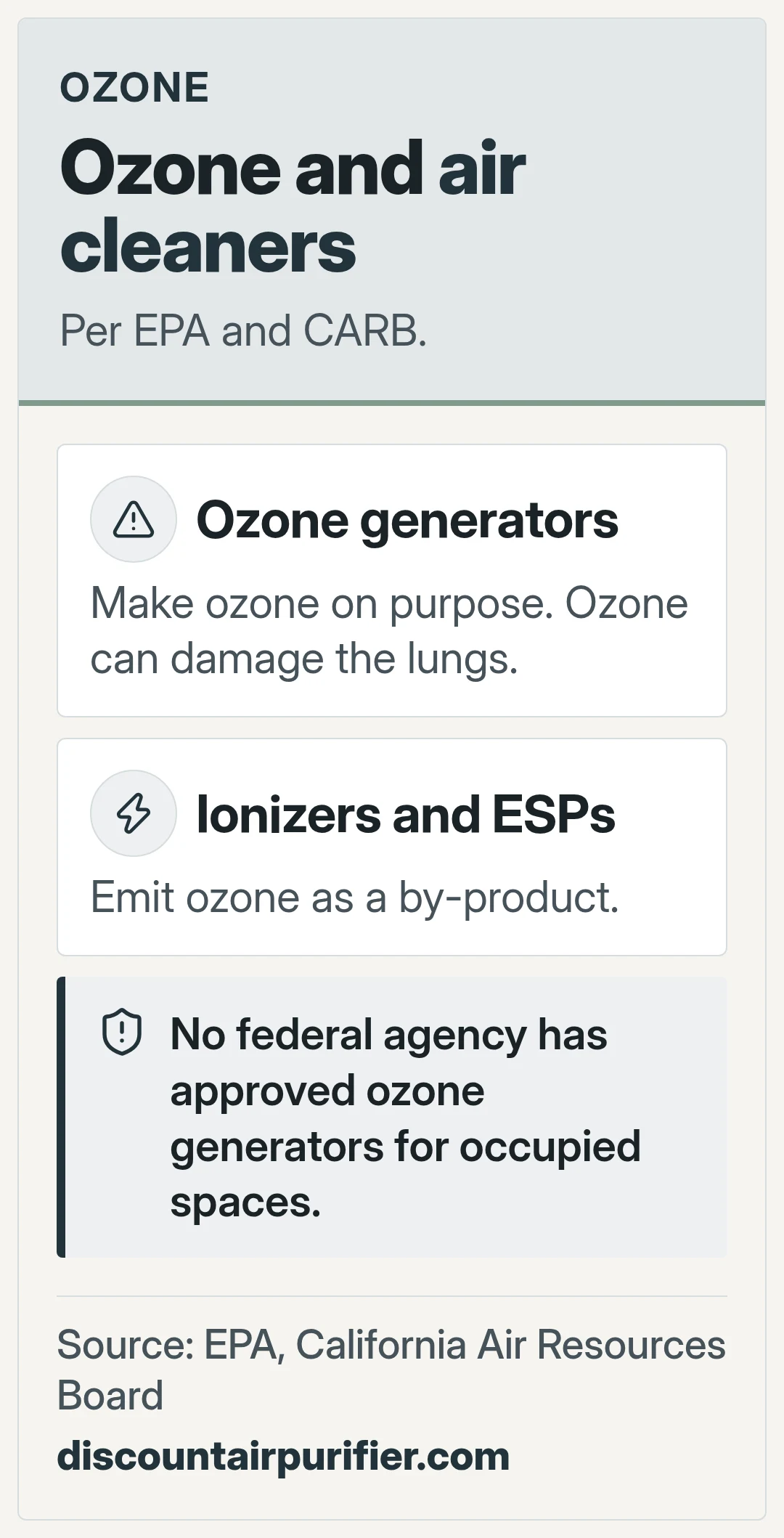
EPA says ozone generators that are sold as air cleaners intentionally produce the gas ozone. It says: "NO agency of the federal government has approved these devices for use in occupied spaces."
Why ozone is a health risk
EPA says: "When inhaled, ozone can damage the lungs." It says relatively low amounts can cause chest pain, coughing, shortness of breath, and throat irritation, and that ozone may also worsen chronic respiratory diseases such as asthma.
Does ozone clean the air?
EPA says available scientific evidence shows that, at concentrations that do not exceed public health standards, ozone is generally ineffective in controlling indoor air pollution. CARB says ozone does not remove particles such as dust and pollen from the air.
What CARB advises
CARB says: "CARB strongly advises against the use of ozone generators in spaces occupied by people or animals." It says ozone generators can produce indoor ozone levels several times higher than the State's outdoor health standards.
Ionizers and electrostatic precipitators
CARB says ionizers and electrostatic precipitators emit ozone as a by-product of their design and function, although they typically emit much less ozone than ozone generators. EPA says ion generators do not remove gases or odors, and may be relatively ineffective in removing large particles such as pollen and house dust allergens.
Other names for ozone
CARB says manufacturers sometimes inappropriately refer to ozone as "activated oxygen," "super oxygenated," or "energized oxygen," which implies that ozone is a healthy kind of oxygen. EPA says: "Ozone is a toxic gas with vastly different chemical and toxicological properties from oxygen."
Sources: EPA, Ozone Generators that are Sold as Air Cleaners; EPA, What are ionizers and other ozone generating air cleaners?; EPA, Guide to Air Cleaners in the Home; California Air Resources Board, Hazardous Ozone-Generating Air Purifiers; California Air Resources Board, Air Cleaner Information for Consumers.
FAQ
General information only. An air purifier is not a substitute for ventilation, for removing the source of a pollutant, or for medical care. Read and follow the maker's manual. The California Air Resources Board strongly advises against the use of ozone generators in spaces occupied by people or animals. If you have asthma, allergies, or heart or lung disease, talk to your doctor. During wildfire smoke, follow local officials and be ready to evacuate. In an emergency, call 911.

Next: CARB Certification
California's ozone rule.
